
Begin Your Free ACLS Course Online Instantly
- Internationally accepted – 98% acceptance rate
- Adheres to the latest ILCOR Standards and Guidelines
- Joint Commission (JCAHO) Compliant
- 100% Online: Use your computer, tablet, or phone
- Exclusive study material, including videos & eBooks
- AMA Category 1 Credits™available (upon purchase)
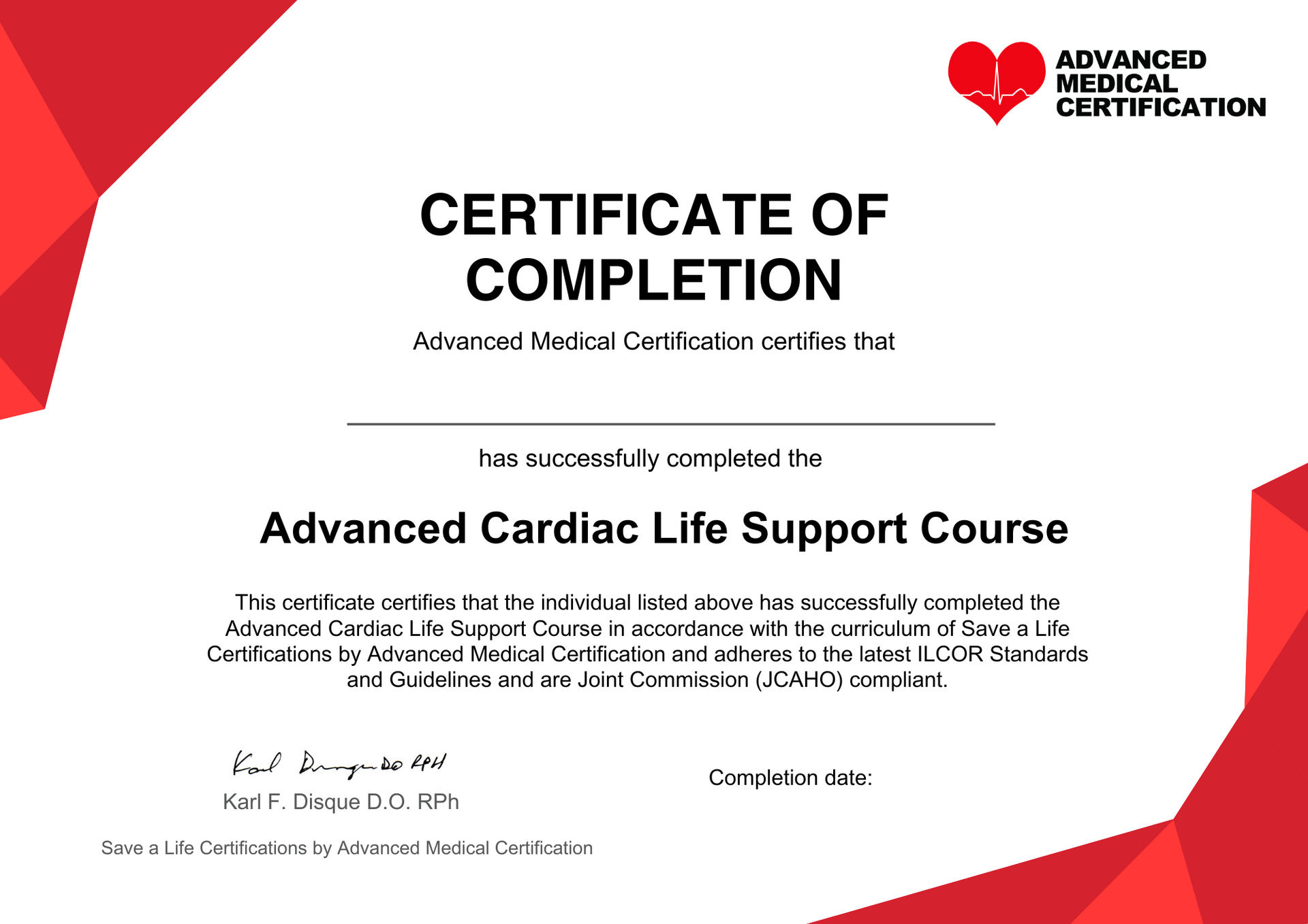
- Free Digital Course Completion Certificate
- Skills Webinars & checklists available
- Test Drive Now –Take our ACLS Practice Test
- ACLS Scenarios –Try our ACLS Megacodes

The idea behind the Save a Life Initiative is simple. Take the same advanced life-saving training we developed for physicians, and give it to the underserved, at home and abroad at no cost. We work in conjunction with the Disque Foundation to fulfill its mission of advancing health care education to the underserved through advanced technology. When we put the knowledge, skills, and ability to perform CPR and other proven techniques in the hands of people around the world, the potential number of lives saved is almost overwhelming.
Save a Life by Advanced Medical Certification, the Disque Foundation and you. Together, let’s save lives.

Everything You Need in a Free ACLS Class
Our comprehensive, free ACLS class is designed to support your convenience and success. Unlike other programs, we offer a complete online learning experience with no hidden fees.
Whether you’re a physician, nurse, paramedic, or healthcare provider, this course equips you with the critical skills needed for Advanced Cardiac Life Support (ACLS).
This free ACLS Course provides up-to-date training based on the latest emergency cardiovascular care guidelines. You’ll gain access to step-by-step lessons, instructional videos, and practice scenarios to ensure you’re fully prepared for real-life medical emergencies.
We are committed to offering a high-quality, free ACLS course to empower healthcare providers everywhere.
By completing this course, you will earn a Free Course Completion Certificate, demonstrating your understanding of ACLS principles and reinforcing your confidence in handling emergency situations.
Start learning today and see why thousands of professionals choose our free ACLS class to advance their skills.
What Will You Learn in this Free ACLS Course?
This ACLS Course provides comprehensive training in Advanced Cardiac Life Support, including:
- Recognition and Management of Cardiac Arrest – Learn how to identify and respond to cardiac emergencies with confidence.
- Advanced Airway Management – Understand airway techniques crucial for patient stabilization.
- Pharmacology in Emergency Care – Explore essential medications used during resuscitation and cardiovascular emergencies.
- Effective Team Dynamics – Master communication and coordination during high-pressure medical situations.
- Post-Cardiac Arrest Care – Understand the critical steps to optimize patient survival and recovery.
After completing the course, you can download your Course Completion Certificate at no cost. If you need an official provider card for professional use, you can choose to upgrade to the full ACLS Certification with CME credits.
10,092,536
Lifesavers empowered
EMPOWERED BY THE

a non-profit organization
188
Countries and territories served
EMPOWERED BY THE
a non-profit organization
9,081,128
Lifesavers empowered
188
Countries and territories served
Compare Your Options: Course Completion Certification vs. CME-Accredited Certification
We offer two excellent options to meet your needs. Begin with our renowned Free ACLS Course to gain invaluable knowledge and receive an instant, free proof of completion.
This is the perfect choice for professionals looking to refresh their skills with a comprehensive and free online ACLS course.
For those who require official documentation for work, licensing, or professional development, our CME-Accredited ACLS Certification is the ideal upgrade.
Why should you purchase the full certification?
While our free courses provide valuable knowledge and a course completion certificate, the full certification offers additional benefits, particularly for professionals who require official documentation for their careers. If you need a provider card for work, licensing, or professional development, upgrading to the full certification is essential.
Advantages of the full certification:
- Recognized Provider Card – Many employers and organizations require a recognized provider card as proof of competency in life-saving skills.
- CME Credits – Continuing Medical Education (CME) credits are required for many health care professionals to maintain licensure and stay current with industry standards.
- Enhanced Credentials – A full certification strengthens your resume and professional credibility, demonstrating your commitment to maintaining up-to-date training.
| Feature | Course Completion CertifIcate | CME-Accredited Certification |
|---|---|---|
| Certification Recognition | Informal acknowledgment of course completion | Professional provider card |
| CME Credits | Not Included | Up to 8 CME credits included |
| Recognized Provider Card | No | Yes, required by many employers |
| Best For | Personal learning & self-improvement | Professional use & career advancement |
| Cost | Free | Starting from $159 |
Health Care Providers Who Love Our ACLS Certifications

Our ACLS, PALS & BLS Courses are accredited by the
Post Graduate Institute of Medicine
, offering Category 1 CEU credits. Therefore these certifications are also Joint Commission compliant.

For your security and peace of mind, all of our courses include a hassle-free refund policy .
If you are unhappy with our course for any reason, our Empowerment Team will refund your purchase.
Advanced Cardiac Life Support (ACLS) Manual
Introduction To ACLS – Get a glimpse of the Advanced Cardiovascular Life Support course. Familiarize yourself with the elements of the course, including course goals.
First Assessment– Know what to do in case of an emergency. Determine whether you should begin with BLS or ACLS in an emergency situation.
2020 BLS Guideline Changes – Update yourself on the 2020-2025 BLS changes recommended by the International Liaison Committee on Resuscitation. Compare and contrast a list of previous and current recommendations.
ACLS BLS For Adults – Introduce yourself to the adult BLS procedure: chest compressions, establishing airway, giving breaths, and using AED for defibrillation. Also, learn the difference between CPR with one rescuer and CPR with two rescuers.
General Concepts Of BLS – Familiarize yourself with an overview of the Basic Life Support. Further, learn about the Chains of Survival for adult and pediatric care.
One Rescuer Adult BLS CPR – Learn how to perform adult BLS and CPR as a lone rescuer. Use the provided diagrams to thoroughly engage yourself in the step-by-step CPR process.
Two Rescuer Adult BLS CPR – Learn how to perform adult BLS and CPR as part of a two-rescuer team.
Adult Mouth To Mask Ventilation – Learn steps to perform mouth-to-mask ventilation as a lone rescuer.
Normal Heart Anatomy & Physiology – Dive into the anatomy and physiology of the heart. Take a journey through the electrical pathways of the heart, including the blood’s way through the atria, ventricles, and other cardiac parts.
The ACLS Survey (A-B-C-D) – Learn about the steps to take during the ACLS survey, which includes Airway, Breathing, Circulation, and Differential Diagnosis (ABCD).
Airway Management – Learn about airway management and techniques. Familiarize yourself with inserting basic airway adjuncts and the knowledge of advanced airways and its equipment.
Basic Airway Adjncts – Become an expert in the use of basic airways: oropharyngeal airway (OPA), nasopharyngeal airway (NPA), and suctioning.
Basic Airway Technique – Learn step-by-step procedure to insert oropharyngeal and nasopharyngeal airways as well as get tips on suctioning.
Advanced Airway Adjuncts – Become an expert in the use of advanced airways: endotracheal tube (ET), laryngeal mask airway (LMA), laryngeal tube, and esophageal-tracheal tube (Combitube).
Routes of Access – Learn about the two priority vascular routes: intravenous (IV) and intraosseous (IO).
Pharmacological Tools – Refresh your memory on ACLS medication. Review the provided table to reference information about adult drug dosage, routes, and uses of common drugs.
Principals of Early Defibrillation – Get a glimpse of defibrillation and AED. Learn about the purpose of defibrillation, principles of early defibrillation, basic AED operations, and delivering shock.
Key to Using Automated External Defibrillator (AED) – Learn in detail on the use of the AED, including the criteria to apply AED and step-by-step procedure to operate an AED.
Systems of Care – Introduce yourself to the Systems of Care based on the ILCOR guidelines. Systems of care describe an organization of professionals necessary to respond during emergencies and in any given circumstances.
Cardiopulmonary Resuscitation – Get to know the steps of the adult CPR Chain of Survival.
Post Cardiac Arrest Care– Learn about the interventions for post-cardiac arrest care: therapeutic hypothermia, optimization of hemodynamics and ventilation, percutaneous coronary intervention, glucose control, and neurological care.
Acute Coronary Syndrome – As a health care provider, learn to recognize individuals with potential ACS. Get your hands on the STEMI Chain of Survival and further learn the goals of ACS treatment.
Acute Stroke– Get your hands on the Stroke Chain of Survival. Further, learn about the goals of Acute Ischemic Stroke Care (the 8 D’s).
The Resuscitation Team – Whether you are a team leader or a team member, team dynamics during resuscitation are vital. Learn about what you can bring to the table as a leader or as a member of the resuscitation.
Education, Implementation, Teams – Introduce yourself to the concepts of Rapid Response Team (RRT) and Medical Emergency Team (MET). Get familiar with tasks to do as a nurse, physician, or even a family member during the event of a cardiac arrest.
Respiratory Arrest – Know what to do during a respiratory arrest, whether it is the ACLS or the BLS steps that you are performing. Further, get to know the types of ventilation (advanced and basic) and the techniques of placing the airways.
Ventricular Fibrillation & Pulseless Ventricular Tachycardia – Study the rules for ventricular fibrillation (VF), ventricular tachycardia (VT), and torsades de pointes. These rules include guidelines for regularity, rate, waves, intervals, and complexes for all three cases.
Pulseless Electrical Activity (PEA) & Asystole – Study the rules for pulseless electrical activity (PEA) and asystole. Learn about the reversible causes of PEA (the H’s and the T’s).
Adult Cardiac Arrest Algorithm – Use the infographic to gain knowledge about the steps to take in case of an adult cardiac arrest. Further, learn how about the quality of CPR you give, shock energy, return of spontaneous circulation (ROSC), advanced airway, drug therapy, and reversible causes of cardiac arrest.
Post-Cardiac Arrest Care – Get a glimpse of what to do after a cardiac arrest has passed: optimize ventilation and circulation; preserve heart and brain tissue and function; and maintain recommended blood glucose levels. Learn how blood pressure support, vasopressors, and hypothermia help during post-cardiac arrest care.
Adult Immediate Post-Cardiac Arrest Care Algorithm – Acquaint yourself with immediate post-cardiac arrest care elements, including ventilation and oxygenation, doses and its details, reversible causes of cardiac arrest, and steps to take in case of return of spontaneous circulation (ROSC).
Symptomatic Bradycardia – Study the rules for sinus bradycardia, first degree AV block, second degree type I AV block (wenkebach), second degree type II AV block (mobitz II), and third degree AV block (complete heart block). These rules include guidelines for regularity, rate, waves, intervals, and complexes for all cases. Further, also get a glimpse of symptoms of bradycardia.
Adult Bradycardia with Pulse Algorithm – Use the infographic to gain knowledge about the steps to take in case of an adult bradycardia with pulse. Also, learn about the symptoms of tachycardia, and what to do in the event of tachycardia pulse being higher than 100 BMP symptomatic.
Stable & Unstable Tachycardia – Study the rules for sinus tachycardia, atrial flutter, and atrial fibrillation (A-FIB). These rules include guidelines for regularity, rate, waves, intervals and complexes for all cases. Also, learn about the symptoms of tachycardia, and what to do in the event of tachycardia pulse being higher than 100 BMP symptomatic.
Adult Tachycardia with Pulse Algorithm – Use the infographic to learn what to do in case of an adult tachycardia with pulse. Also get a quick glimpse of dosages for adult tachycardia with pulse.
Acute Coronary Syndrome – Learn about ACS and its symptoms; and get a glimpse of the EMS pathway.
Acute Coronary Syndrome Algorithm – Use the infographic to learn what to do when rescuing someone with ACS.
Acute Stroke – Learn about Acute Stroke and its symptoms; and get a glimpse of the EMS pathway. Further, review the goals set by National Institute of Neurological Disorders and Stroke (NINDS) for situations when the time of symptom onset is known.
Acute Stroke Algorithm – Use the infographic to learn what to do when rescuing someone suffering from Acute Stroke.
Learn More
What is included in the ACLS Course?
- Access to the Advanced Cardiac Life Support (ACLS) Provider Handbook in PDF format.
- Online training with no in-person skills test required.
- Unlimited exam retakes at no additional cost.
- Instant access to proof of certification upon passing the exam.
- Eligibility for CME credits (up to 8 AMA Category 1 Credits™).
- Access to the Advanced Cardiac Life Support (ACLS) Provider Handbook in PDF format.
Can I retake the ACLS exam if I don’t pass on my first attempt?
Yes! If you do not pass the certification exam on your first attempt, you can review your results, compare answers with the provider handbook, and retake the exam at no additional cost.
What occupations typically need ACLS?
Health care professionals who take our ACLS Course include:
- Home Care Providers
- Doctors (MDs)
- Nurses (RNs)
- Nurse Practitioners (NPs)
- Physician Assistants (PAs)
- Paramedics
- CRNAs
- Pharmacists
- Certified Clinical Medical Assistants
- Dentists & Dental Hygienists
- Daycare Providers & Caregivers
- Home Care Providers
What is the Course Completion Certificate, and how does it differ from the CME-Accredited Certification?
The Course Completion Certificate acknowledges that you have completed the ACLS Course. However, it is not the same as the CME-Accredited Certification. The CME-Accredited Certification includes a recognized provider card and CME credits, which are often required by employers.
How can I upgrade to the CME-Accredited Certification after receiving my Course Completion Certificate?
Once you complete the ACLS Course and earn your Course Completion Certificate, you can upgrade at any time by purchasing the CME-Accredited Certification. This upgrade provides an official provider card and CME credits to meet workplace and licensing requirements.
Ready to Begin? Your Free ACLS Course is One Click Away.
There's no cost and no obligation. Get immediate access to all training materials and earn your completion certificate today.